
Watch Water Resistance Ratings: What 30m, 50m, and 100m Actually Mean
The 30m stamped on the caseback does not mean you can swim 30 meters down. It means the watch survived a static pressure test equivalent to that depth, in a lab, on a brand new gasket, with the crown screwed down and nothing moving. Real water exposure looks nothing like that, and the gap between lab ratings and pool reality is where most water damage claims come from.
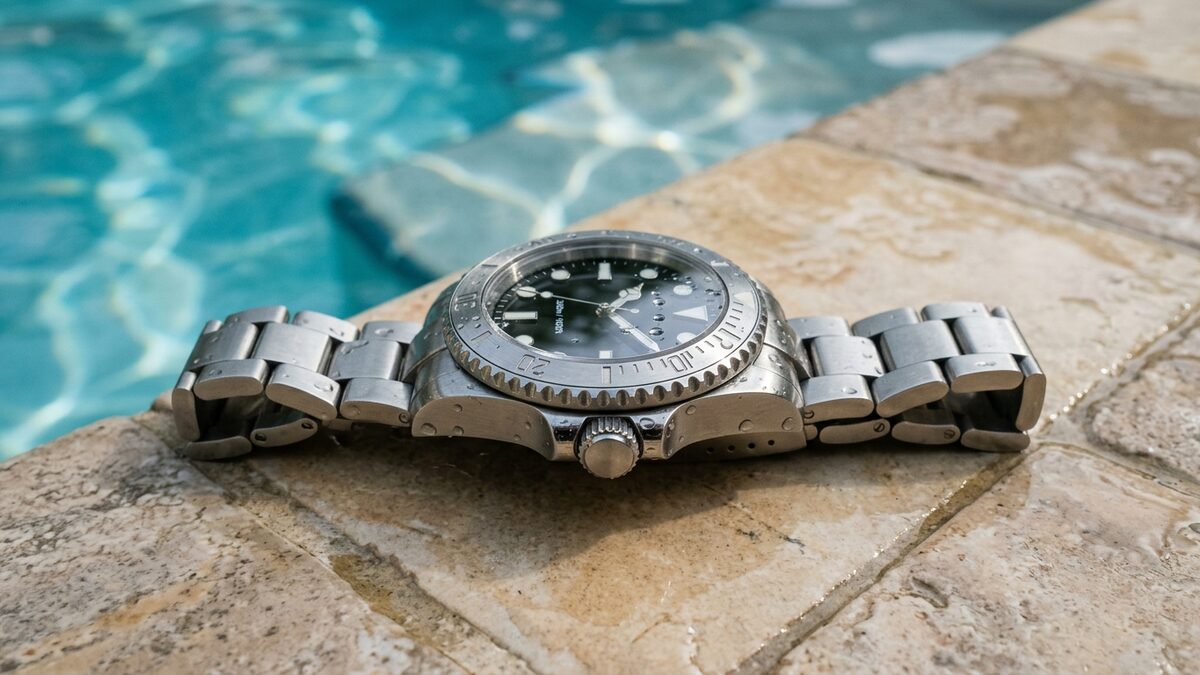
Water resistance ratings on watches are one of the most consistently misunderstood specs in the industry, and the confusion is not entirely the buyer's fault. The numbers look like depth limits because they are printed in meters, but they are actually pressure ratings derived from a static test. The watch sits motionless in a chamber while pressure is increased to simulate a given depth. Nothing flexes, nothing impacts, nothing ages. That is the test your 30m watch passed, and that is why it should never see a swimming pool.
Here is the practical translation most enthusiasts settle on after a few ruined movements. A 30m rating means splash resistance only. Hand washing, getting caught in rain, wiping it down with a damp cloth. No showers, no swimming, no submersion of any kind. The pressure spike from a faucet alone can exceed 30m when water hits the case at the wrong angle, and shower steam is worse because heat expands the metal and contracts the gaskets unevenly.
50m starts to allow brief contact with water under controlled conditions. You can wash your hands without thinking about it, get caught in a downpour without panic, and some owners feel comfortable with quick pool dips. Swimming laps is still pushing it. The reason is dynamic pressure, the spike that happens when your arm moves through water. A breaststroke pull can generate pressure equivalent to several atmospheres at the moment of peak motion, briefly exceeding the static rating the watch was tested at.
100m is where swimming becomes reasonable. Pool laps, ocean wading, snorkeling at shallow depth. This is the rating most enthusiasts consider the practical baseline for a watch they want to stop worrying about. It is also where you should start paying attention to crown design. A push-pull crown at 100m is fine for swimming but should be checked before every water exposure to confirm it is fully seated. A screw-down crown at the same rating is more forgiving and is the design you want if water contact is part of your routine.
The gasket problem nobody warns you about
Every water-resistant watch has rubber or silicone gaskets sealing the caseback, crown, and crystal. These gaskets are consumables. They dry out, compress, and lose elasticity over time, regardless of whether the watch ever sees water. A 100m watch that has not been serviced in eight years is not a 100m watch anymore. It is an unknown, and the only way to find out is a pressure test.
Most manufacturers recommend pressure testing annually if the watch is used in water, and every two to three years if it is not. The test takes about ten minutes at a competent watchmaker and costs roughly fifteen to thirty dollars. It is one of the cheapest forms of insurance in the hobby. If the watch fails, the watchmaker replaces the gaskets and retests, usually for under a hundred dollars total. If it passes, you get another year of confidence.
The crown is the single biggest failure point. On a screw-down design, the threads themselves wear over time, and the gasket inside the crown tube compresses with every pull-out. Owners who set the time daily are aging that gasket faster than owners who set it monthly. On a push-pull design, the gasket is the only barrier, and a single instance of forgetting to push the crown back in before water exposure is enough to flood the movement.
200m and 300m ratings exist for a reason, and that reason is not that anyone is actually diving to those depths. The extra margin accounts for gasket aging, dynamic pressure, and the inevitable moments when someone forgets to check the crown. A 300m dive watch will tolerate a missed crown check far better than a 100m sports watch will, and that buffer is what you are actually paying for.