
How Often Should You Service a Mechanical Watch? A Practical Owner's…
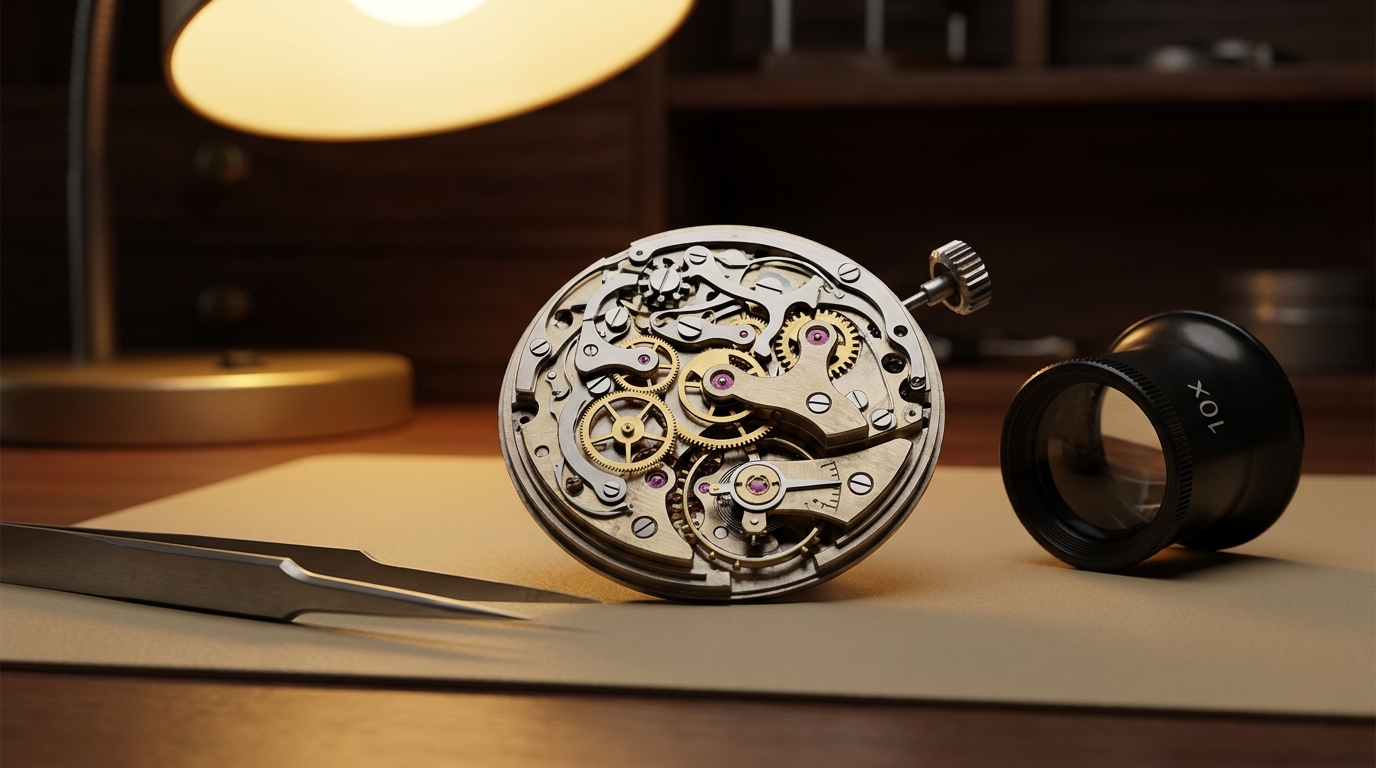
Ask ten collectors when to service a mechanical watch and you'll get ten answers, most of them quoting a brand's service brochure. The truth sits in the messy middle: between the conservative 5-year manufacturer recommendation, the 7 to 10 years many independent watchmakers consider reasonable, and the contrarian crowd who runs vintage pieces for decades on a single overhaul. None of them are wrong, exactly. They're just optimizing for different things.
The standard advice goes like this: every 5 to 7 years, send your mechanical watch in for a full service. Lubricants degrade, gaskets harden, and a movement running dry will eventually shred its own pivots. That part is true. What the advice leaves out is that 5 to 7 years is a manufacturer-friendly window, calibrated to the assumption that you wear the watch daily, in varied conditions, and want it to keep performing within its original tolerances.
Most enthusiasts don't actually live that way. If you rotate through six watches and a particular piece sees the wrist a few days a month, its lubricants are oxidizing on a different schedule than the brochure assumes. A watch resting most of the year on a soft cushion is aging chemically, not mechanically. The oils still break down, but the gear train isn't grinding through them. Real-world service intervals often stretch comfortably past the official number, sometimes well past, with no harm done.
What actually happens during a full service
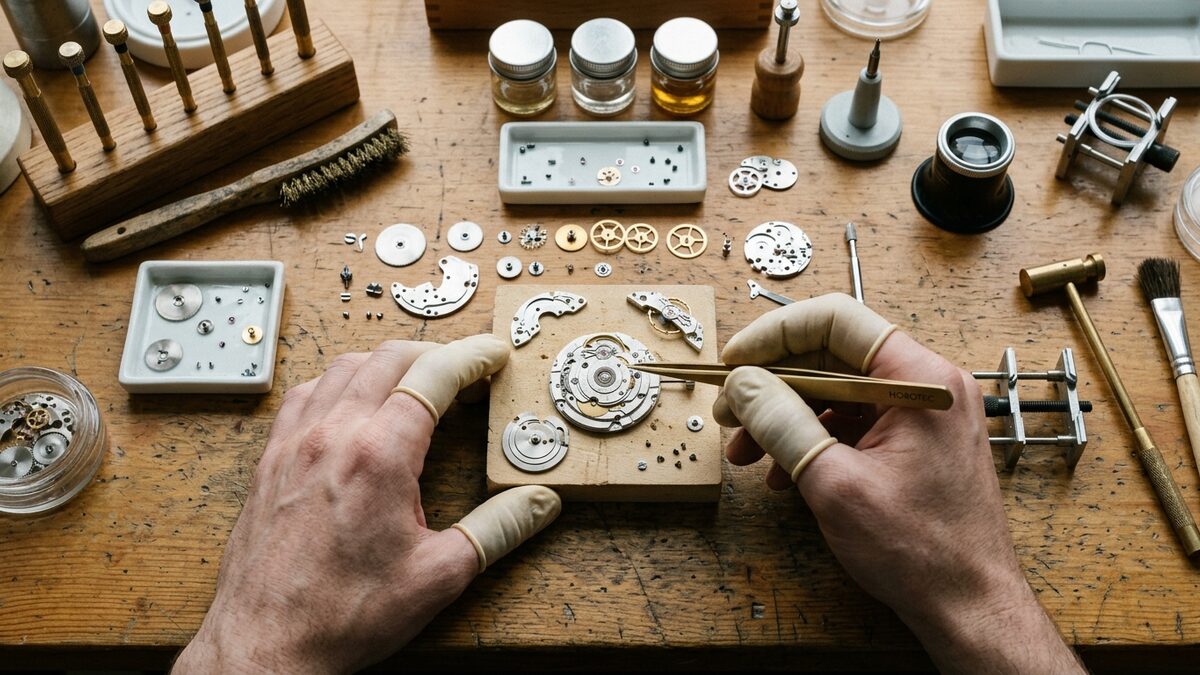
A complete overhaul is more involved than most owners realize. The watchmaker disassembles the movement entirely, down to individual screws and jewels. Every component gets cleaned in an ultrasonic bath with specialized solutions to strip aged lubricants and contaminants. Pivots are inspected under magnification for wear. The mainspring is replaced as a matter of course on most services because a fresh spring is cheap insurance against torque variation. Gaskets at the crown, caseback, and crystal are replaced. Then everything is reassembled, lubricated point by point with the correct oils and greases for each contact surface (a movement uses three to five different lubricants in tiny, precise amounts), and the watch is regulated on a timing machine across multiple positions.
After regulation, the watch typically rests for a few days under observation, then gets a pressure test if it's water-resistant. A proper service is a full week of bench time, not an afternoon. That's why it costs what it costs, and why turnaround times of two to four months at brand service centers are normal rather than negligent.
Signs your watch needs attention before the recommended interval are worth knowing. A sudden change in accuracy is the loudest signal: if a watch that has been holding plus or minus 5 seconds a day drifts to plus 30, something has shifted. Reduced power reserve is another, meaning the watch dies overnight when it used to run two days off the wrist. Visible moisture under the crystal means the gaskets have failed and you need service immediately, not on a calendar. A grinding or scratchy feeling when you wind the crown can indicate a worn keyless works, which is annoying to repair but cheap if caught early.
Brand service versus independent watchmakers
The brand service center route gets you factory parts, factory training, and a warranty on the work. It also gets you the highest bill, the longest wait, and sometimes cosmetic restoration you didn't ask for. Some brands polish cases by default during service, which is great if you wanted that and devastating if you valued the original sharp edges and patina. Always specify in writing that no polishing is to be performed unless explicitly authorized.
A skilled independent watchmaker often does equivalent work for 40 to 60 percent of the brand price, with faster turnaround and a conversation about what you actually want done. The catch is parts access. Several major brands restrict spare parts to authorized centers, which means an independent can do the labor but may not be able to source a specific bridge or balance complete if something is genuinely broken. For routine service on common movements, this is rarely an issue. For obscure or modern in-house calibers, it can be a dealbreaker.
Cost expectations vary wildly by tier. A service on a workhorse Swiss movement at an independent runs roughly 350 to 600 dollars in most major markets. The same service at a brand center for an entry-luxury piece often lands between 700 and 1100. Higher complications, chronographs, perpetual calendars, minute repeaters, scale up steeply, and a full service on a high complication can run several thousand dollars without anything being wrong. That's the cost of the bench time the work demands.
The honest question for vintage and lower-value pieces is whether the service is worth more than the watch. A 400-dollar service on a 600-dollar vintage watch is a hard sell unless the piece has sentimental value or you genuinely intend to wear it. For pieces in that range, many owners take a pragmatic approach: run the watch until it stops keeping reasonable time, then evaluate. If it's still cosmetically intact and you enjoy it, service it. If not, retire it to the drawer and put the service money toward something you'd actually wear. There's no shame in that math.
The takeaway is that service intervals are guidelines optimized for risk-averse outcomes, not deadlines. Pay attention to how your watch actually runs. A piece holding good time, with a healthy power reserve and a dry case, is telling you it's fine. A piece showing any of the warning signs above is telling you something different. Listen to the watch, not the brochure.