
Watch Movement Types Explained: Quartz, Automatic, and Manual
Walk into any pre-owned watch conversation and within five minutes someone will say the word movement. It's the engine inside the case, and the type you choose shapes how the watch feels on your wrist, how often it visits a watchmaker, and how much you get back when you sell. The three families you'll encounter again and again are quartz, automatic, and manual wind. Each has a personality, and none of them is objectively better than the others.
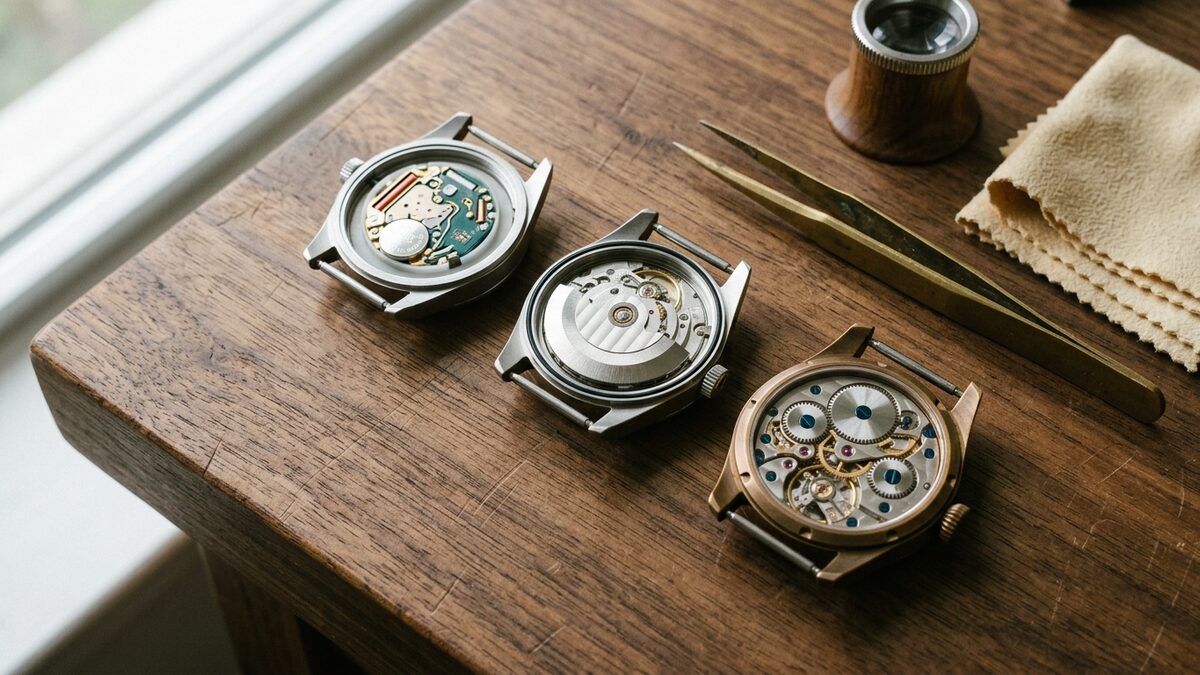
Quartz is the most common movement on the planet, and for good reason. A small battery sends current through a quartz crystal, which vibrates at a precise frequency, and a tiny circuit translates those vibrations into the steady tick of the seconds hand. Accuracy is excellent, typically within 15 seconds a month, and you don't need to wind or wear it to keep it running. For a daily-beater field watch, a travel companion, or a first nice watch for a teenager, quartz is hard to beat. Service is mostly a battery swap every two to four years, sometimes with a gasket refresh, and most jewelers can handle it without sending the watch out.
The trade-off shows up at resale. Quartz watches generally hold less value than mechanical equivalents from the same brand, with a few notable exceptions like vintage Seiko Grand Quartz pieces or certain Cartier Tank references. If you're buying primarily as a wearer and not as an asset, that's fine. If you want the watch to be worth something close to what you paid in five years, quartz is a harder argument outside those specific collector niches.
Automatic Movements and the Romance of the Rotor
Automatic, sometimes called self-winding, is the movement type that dominates the modern luxury market. Inside the case, a weighted rotor spins as your wrist moves, winding the mainspring and storing energy. Wear it daily and it never stops. Set it down for two or three days and it runs out of power and needs a wind and a time reset. Power reserves vary, with most modern movements sitting between 38 and 80 hours, and a few specialty calibers stretching past a week.
The appeal goes beyond function. You can usually feel the rotor swing when you move your wrist, and many cases now have display backs so you can watch the mechanism breathe. Accuracy is good but not quartz-good, generally within plus or minus 10 seconds a day for a well-regulated piece, tighter for chronometer-certified movements. Service intervals are the real ongoing cost. Most brands recommend a full service every four to seven years, which can run anywhere from $400 for a basic three-hand caliber to several thousand for a complicated chronograph from a high-end maison. Budget for that before you buy, not after the watch starts running fast.
For resale, automatic is where the pre-owned market lives. Most of the references that hold or appreciate, from sports models to dress pieces, are automatic. If you're thinking of a watch as a long-term hold, this is usually the category to shop in.
Manual Wind: The Quiet Discipline
Manual movements skip the rotor entirely. You wind the crown every day or two, feel the resistance build up as the mainspring tightens, and stop when it firms up. This sounds like a chore until you do it for a week and realize it becomes a small ritual, the way some people enjoy grinding their own coffee. Without the rotor, manual movements are typically thinner, which is why a lot of classical dress watches are hand-wound. You also get a cleaner view of the movement through a display back, with no rotor blocking the bridges and balance.
Accuracy and service costs land in the same neighborhood as automatics, though some watchmakers find manual calibers slightly cheaper to service because there are fewer components. Power reserves tend to be shorter on vintage pieces, often 36 to 42 hours, so you'll feel the wind cycle more often than you would with a modern automatic. For someone who likes the tactile relationship with the watch and doesn't mind the daily attention, manual is genuinely satisfying. For someone who wants to grab a watch out of the box and have it running, it's a worse fit.
So how do you choose? Think about how you actually live. If you rotate through five watches and most of them sit for days at a stretch, quartz or manual is more honest, because automatics in a drawer are just dead automatics. If you wear one watch most days and want the broadest resale market, automatic is the safe pick. If you want a thin dress piece for evenings and you like rituals, manual is the connoisseur's answer. The movement isn't the only thing that matters when you buy, but it's the one decision that affects every single day you own the watch.