
Watch Lume Explained: Tritium, Super-LumiNova, and Chromalight
Lume is the quiet feature you only notice in the dark, and the one that most reveals how a watch was made. The glow on a dial tells you something about the era, the brand's priorities, and sometimes the condition of a vintage piece sitting under glass. Knowing the families of luminous material, how they age, and what the trade-offs are turns a midnight glance at the bedside table into a small lesson in horology.
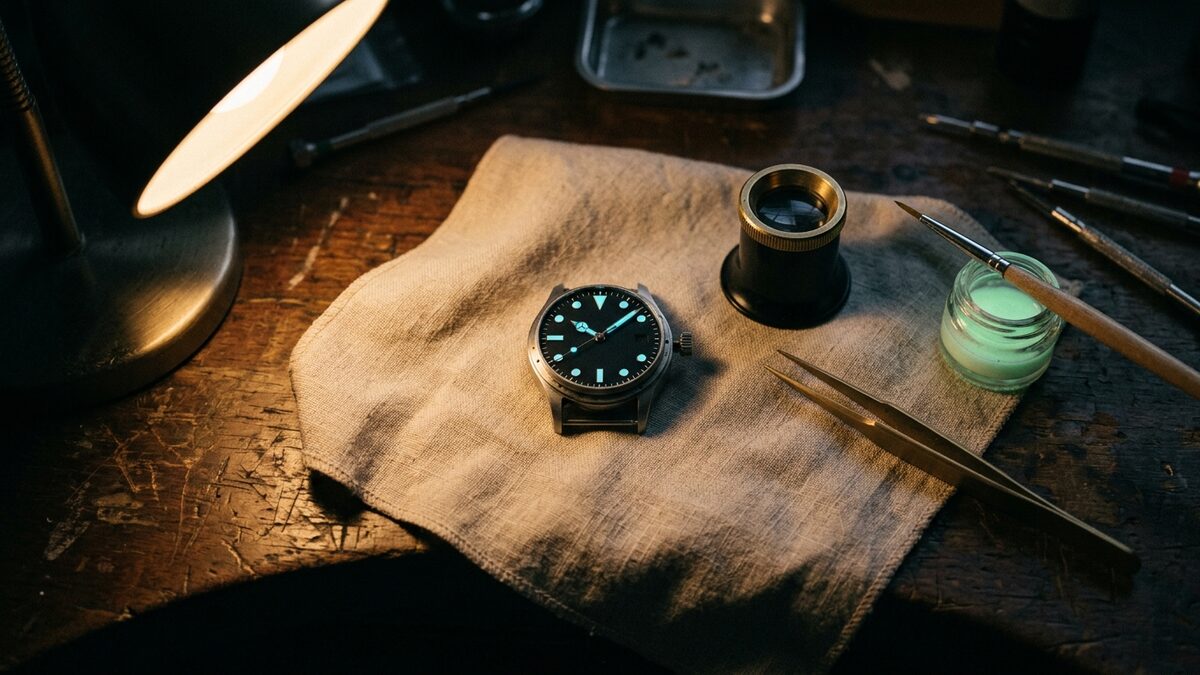
Watch lume has gone through three broad chapters: radioactive paints that generated their own light, photoluminescent pigments that store and release energy, and the proprietary refinements brands have layered on top of the second category. Each chapter solved a problem the previous one created, and each left behind a population of watches that collectors still chase, repair, and argue about.
The earliest dials used radium-based paint, which glowed continuously thanks to radioactive decay exciting a zinc sulfide phosphor. It worked beautifully for decades, then kept working long after the phosphor itself had burned out, leaving dials that are still mildly radioactive but no longer luminous. Radium was largely phased out by the 1960s after the health consequences for dial painters became impossible to ignore. Watches with original radium dials are generally safe to wear in normal conditions, but service techs treat them with respect and the paint is never disturbed without proper precautions.
Tritium replaced radium and ran the show through the 1990s. It is also radioactive but far less energetic, with a half-life of about 12.3 years. That half-life is the reason vintage tritium dials look the way they do today: a piece from 1975 has cycled through roughly four half-lives, so the glow is essentially gone even though the warm cream or pumpkin patina remains. Collectors prize that aged tone, and dials marked T or T SWISS T below the six are part of how the era is dated. A separate branch of tritium technology, gas tubes sealed in glass, still appears on tool watches from brands like Ball and Luminox; those tubes glow continuously for roughly two decades without needing a charge.
How Super-LumiNova Changed The Equation
The shift to photoluminescent compounds in the mid 1990s was driven by Nemoto and Company in Japan, whose LumiNova pigment was licensed to a Swiss joint venture and became Super-LumiNova. The chemistry is strontium aluminate doped with europium, and unlike the older zinc sulfide phosphors it stores significantly more light and releases it more slowly. A modern Super-LumiNova application charged by sunlight or a bright lamp will read clearly for the first hour and remain legible for several more, depending on the grade and thickness of the application.
Super-LumiNova comes in a catalogue of grades and colors, and the differences matter. Standard grades like C1 and C3 give the classic blue-green and yellow-green emissions seen on most dive watches. Newer grades such as X1 and the BGW9 family push brightness or shift toward a cleaner blue-white emission, which is what gives many modern Swiss watches that crisp icy look in the dark. Older watches that have been relumed during service may use a different grade than the original, which is why a vintage piece can suddenly look brighter than its dial peers after a trip to the watchmaker.
Chromalight And The Brand-Specific Variants
Chromalight is Rolex's proprietary luminous compound, introduced around 2008 and used on most current sports models. It emits a long-wavelength blue rather than the green most photoluminescent pigments produce, and the brand claims a longer afterglow than standard Super-LumiNova. In practice the differences between top-grade Super-LumiNova and Chromalight are subtle, but the color is distinct enough that you can usually identify a modern Submariner in the dark from across a room.
Several other brands have introduced their own labels for what is broadly the same family of strontium aluminate chemistry, sometimes tuned for specific brightness or color targets. Seiko's LumiBrite is a notable example with a long track record on dive watches. The marketing varies, but the underlying physics is consistent: charge with light, release as you glance.
For collectors, the practical takeaways come down to a few points. Vintage tritium dials are dead as light sources but valuable as aesthetic objects, and the patina is part of the story. Relumed dials should be disclosed by sellers, since they can affect both appearance and value. Modern lume quality varies more than buyers expect, and a quick test in a dark closet after a few minutes near a window is the cheapest way to assess it. And if you collect dive watches specifically, the brightness and longevity of the lume is a legitimate functional spec, not just a marketing line.
The glow on a wrist at 2 a.m. is one of the more honest pleasures of mechanical watch ownership. Knowing what is producing it makes the moment a little richer.