
Watch Complications Explained: From Date Windows to Perpetual…
A watch that just tells the time is a lovely thing, and for plenty of people it is the whole point. But the moment a dial starts doing more, showing a date, a second time zone, the phase of the moon, the hobby cracks wide open. Here is a plain-language tour of what each trick actually does, and how much watch you really need.
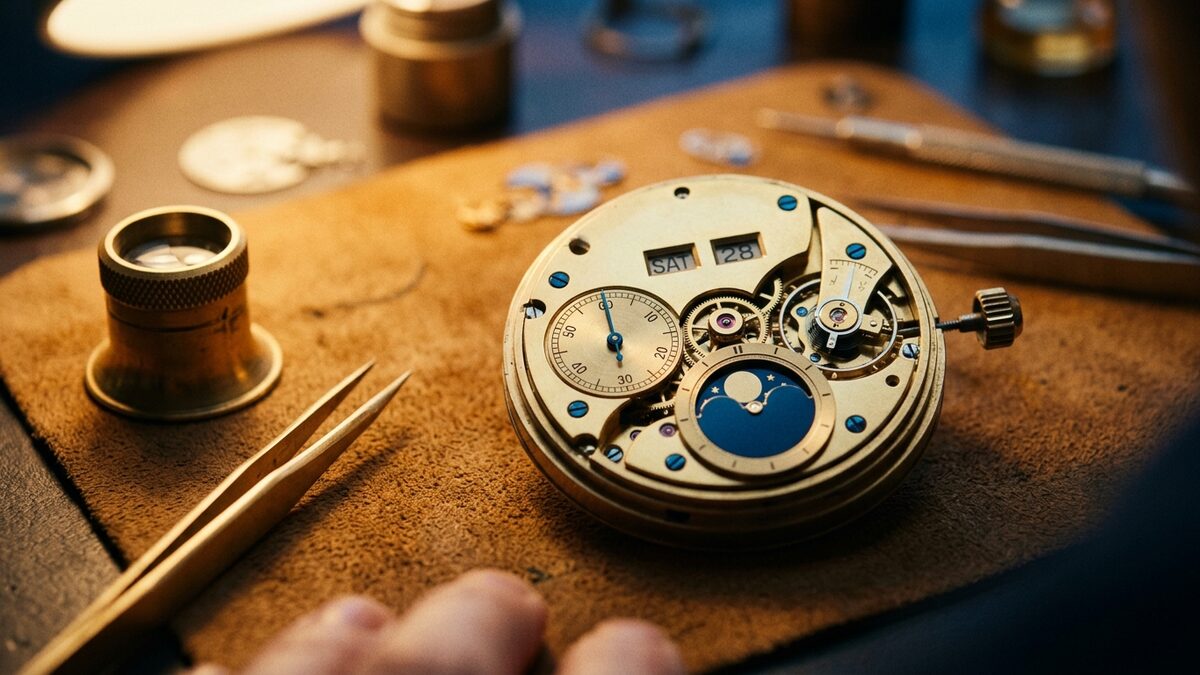
Complications are simply the functions a movement performs beyond hours, minutes, and seconds. Some of them quietly earn a place on your wrist every single day. Others are gorgeous party pieces you might glance at twice a year. Neither is wrong. The trick is knowing which camp a feature falls into before you pay for it, because complexity has a way of following you to the service counter.
One gentle warning before we start: every complication you add is another thing to read, another crown position to remember, and another few grams of price. A crowded dial can look busy fast. The most satisfying watches often carry one or two functions done well rather than a dashboard of features fighting for attention.
Everyday complications that actually earn their keep
The humble date window is the gateway drug. A little aperture, usually at three o'clock, ticking over at midnight. It is genuinely useful, cheap to service, and almost universal. Its close cousin, the day-date, adds the weekday spelled out, which sounds trivial until you realise how often you reach for it. If you want one complication and no fuss, this is the one to choose.
A GMT or dual-time function is the frequent flyer's favourite, and the best complication for anyone who travels or works across time zones. A fourth hand tracks a second zone on a 24-hour scale, so you can keep home time and local time at a glance. It is mechanically simple, reliable, and it holds value well because demand for travel watches never really cools. If you are building a buying guide in your head, a solid GMT belongs near the top.
The chronograph, a stopwatch built into the watch, is the most popular complication of all, and the one most likely to sit unused. Pushers start, stop, and reset a timing function that is brilliant for parking meters and pasta, and largely ignored the rest of the time. That is fine. Chronographs look fantastic, the pusher action is satisfying, and clean examples can hold value beautifully. Just be honest that you are buying it for love as much as utility.
Worth a quick mention here is the power reserve indicator, a gauge showing how much wind is left in the mainspring. On a manual watch it is properly practical, telling you when to top up. On an automatic it is more of a reassurance dial, but it looks purposeful and costs little in complexity. File it under mildly useful and easy to live with.
Grand complications, and whether the romance is worth it
Now we drift into fun-to-own territory. A moonphase shows the waxing and waning of the moon through a little painted disc, and it is pure charm. Practical? Not remotely, unless you garden by lunar cycles. But it is one of the more affordable ways to add a touch of poetry to a dial, and it rarely commands a huge premium, which makes it a sweet spot for buyers who want character without the grand price tag.
An annual calendar is where things get clever. It tracks the date correctly through months of thirty and thirty-one days, needing only a single correction each year at the end of February. For most people this is the genuine sweet spot of calendar watches: nearly no fuss, real day-to-day usefulness, and a sensible step down in cost and service complexity from its more famous sibling.
The perpetual calendar is the showstopper. It knows the length of every month and even accounts for leap years, so in theory it never needs a date correction until the year 2100. It is a marvel of engineering, it photographs beautifully, and it is the kind of thing that makes collectors go quiet. It is also expensive to buy, expensive to service, and unforgiving if you set it incorrectly. This is a heart purchase, not a head one, and there is no shame in that.
Which brings us to the two questions every buyer forgets to ask: what does this cost to service, and do these complications hold value? As a rule, complexity and service intervals move together. A time-and-date watch is a simple, affordable visit. A perpetual calendar or a split-seconds chronograph is a specialist job with a specialist bill. On resale, the pattern is broadly kind to the useful stuff, GMTs, clean chronographs, and well-known calendar references, and less kind to novelty for its own sake.
It is also worth remembering that the case metal shapes both price and resale as much as the complication does. A steel travel watch tends to be the everyday hero and the easier resale; the same reference in gold is a statement piece that asks more of your budget and your nerve. Match the metal to how you actually plan to wear it.
Before you commit to anything with a calendar or a chronograph, there are a few things worth checking. Confirm how the pushers and correctors behave, since setting a complicated watch outside its safe window can damage the movement. Ask about the last service and whether parts are still supported. And factor the service cost into the purchase price, not as an afterthought, because a bargain complication with an orphaned movement is no bargain at all.
So how do you choose complications without over-buying? Start with your actual life. If you travel, a GMT is money well spent. If you love the ritual of a stopwatch, get the chronograph and use it. If you simply want something with soul on the weekend, a moonphase delivers joy per dollar that few features match. Buy the complication you will genuinely reach for, add one you love just because, and let the rest stay in the display case where you can admire them guilt-free.