
Watch Case Size Guide: How Diameter, Lug-to-Lug, and Thickness…
You found the watch. The listing says 40mm, your friend's 40mm wears great, so this is a safe bet, right? Not quite. That one number hides two measurements that actually decide whether a watch hugs your wrist or hangs off it like a dinner plate.
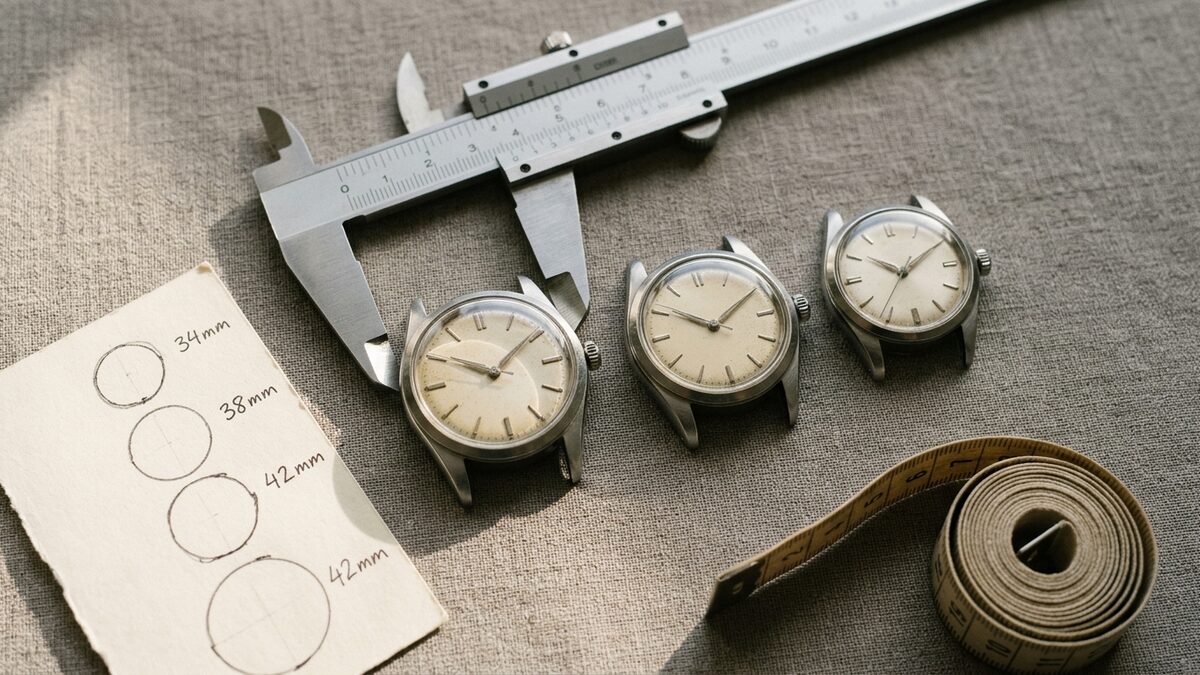
Diameter is the headline figure, and the watch industry loves it because it is easy to print and easy to compare. The trouble is that two watches sharing the same diameter can wear completely differently. One disappears under a shirt cuff; the other looks like it is trying to escape. The variables doing the real work are lug-to-lug length and case thickness, and once you start reading those, you stop getting surprised when a box arrives.
Think of diameter as the width of the dial-and-bezel circle when you look straight down. It matters, but your wrist is not a flat target. It curves, and the watch has to sit across that curve without its ends poking past the edges. That is where the other numbers come in.
Why lug-to-lug beats diameter every time
Lug-to-lug is the distance from the tip of the top lugs to the tip of the bottom lugs, measured along the length of the case. This is the footprint that has to land on your wrist. If your wrist measures 165mm around and the watch has a 50mm lug-to-lug, the lugs will likely overhang and dig in, no matter how modest the 40mm diameter sounds on paper.
Here is the fun part: lug shape changes everything. A dive watch with thick, straight lugs eats more wrist than a dress piece with lugs that curve sharply downward. Those downturned lugs grip the sides of your wrist and pull the case into your skin, so a 48mm lug-to-lug can feel smaller than a flat 46mm. When you scan a pre-owned listing, hunt for the lug-to-lug figure first. Sellers who include it usually know their watches; sellers who only list diameter are hoping you will not ask.
A rough rule that saves a lot of regret: your lug-to-lug should not exceed the flat width of your wrist where the watch sits. Measure that flat width with a ruler across the top of your wrist bone. If the case footprint runs longer than that span, the lugs are going off the edge, and the watch will rock instead of resting.
Thickness is the quiet third factor, and it is the one people forget until a cuff refuses to slide over the case. A 12mm-thick watch feels balanced and slips under a sleeve without a fight. Push past 14mm and the watch starts to feel tall, tipping forward on smaller wrists and catching on door frames. Dive watches and chronographs run thick by nature because of their movements and crystals, so a chunky number is not a flaw, just a thing to expect. If you live in long sleeves, thickness will shape your daily happiness more than any other spec.
How to measure your wrist and read a spec sheet
You need two numbers, and a flexible tape or a strip of paper gets you both. First, wrap the tape around your wrist where you wear a watch and note the circumference. Second, lay a ruler flat across the top of your wrist and measure the width from edge to edge. Write both down. That second measurement is the one almost nobody takes, and it is the one that predicts lug overhang.
As a loose translation, wrists under 160mm in circumference tend to look best with diameters around 36 to 39mm and lug-to-lug under 47mm. Wrists in the 160 to 180mm range open up to roughly 38 to 42mm with lug-to-lug up to about 50mm. Past 180mm, you can carry 42mm and beyond with comfortable headroom. These are starting points, not laws; style and lug shape bend them constantly, and a thin dress watch always wears smaller than its numbers suggest.
When a listing gives you diameter, lug-to-lug, and thickness together, you can picture the watch on your arm before it ships. Stack those three against your two wrist numbers and the guesswork mostly evaporates. If a seller lists only diameter, message them and ask for the other two. A genuine enthusiast will have them ready, and the answer tells you something about who you are buying from.
One more trick for the truly cautious: print a paper template at actual size. Plenty of watch communities share 1:1 dimension sheets you can cut out and tape to your wrist. It looks a little silly, but a thirty-second paper test has talked more than one buyer out of a watch that would have spent its life in a drawer.
None of this means the spec sheet replaces trying a watch on. Wrist shape, where your bone sits, and personal taste all play a part that no number captures. What these measurements do is shrink the gamble. Pre-owned buying is the one place where you cannot strap the watch on first, so the numbers are your stand-in for the wrist test. Learn to read all three of them, keep your two wrist figures in your phone, and you will stop ordering watches that look perfect in photos and feel wrong in the flesh. The right fit is mostly arithmetic, and now the math is on your side.