
Watch bracelet sizing: how to get the fit right on a pre-owned piece
A pre-owned watch almost never arrives sized to your wrist. The previous owner had a different forearm, a different summer-to-winter swing, a different idea of where a clasp should sit. Getting the bracelet right is the difference between a piece you wear every day and one that lives in the box because it pinches at 3pm.
The first thing to understand is that wrist size is not a single number. It changes through the day, sometimes by a full link's worth. Wrists swell in heat, after meals, after a workout, on long flights. They contract in cold weather and in the morning before coffee. A bracelet sized perfectly at noon in July can feel like a tourniquet at noon in January. The goal is not a single perfect measurement; the goal is a fit that tolerates the swing.
Start by wearing the watch unsized for a day if the bracelet is long enough to clasp safely. Pay attention to where it settles on your wrist. A properly fitted bracelet should rest just behind the wrist bone, with the watch head sitting on top of the wrist rather than sliding around to the side. If the head migrates as you type or drive, the bracelet is too loose. If it leaves a deep impression after twenty minutes, it is too tight.
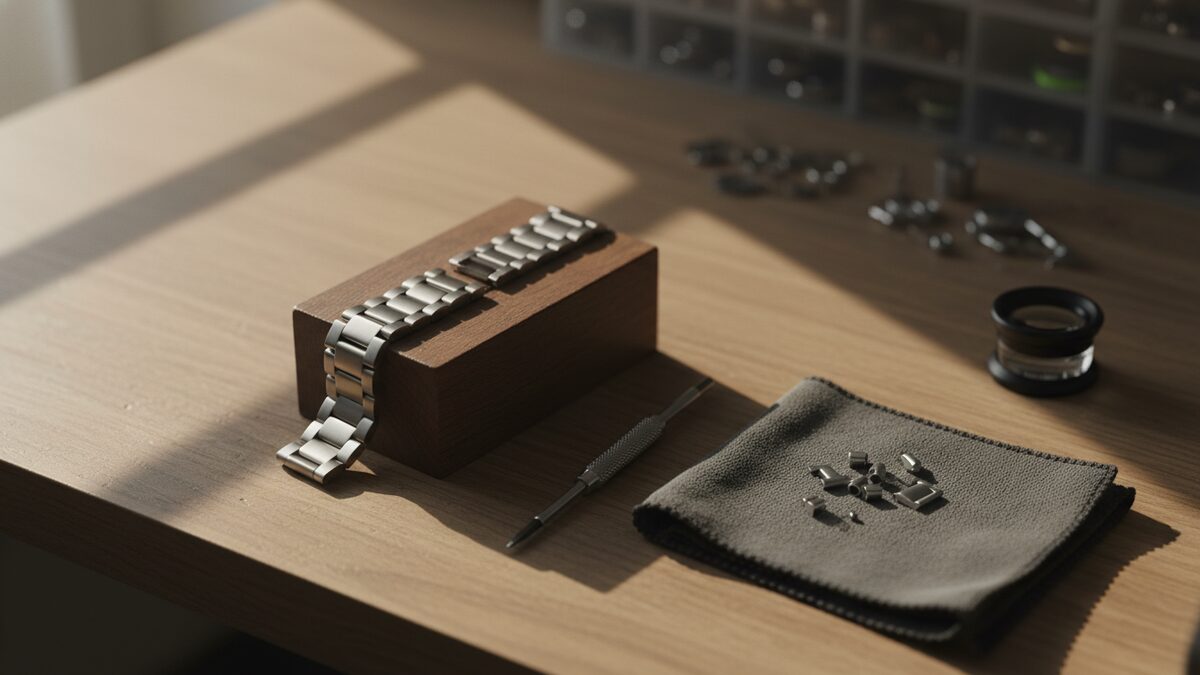
Link removal is the obvious next step. Most modern bracelets use screwed links or pin-and-collar links. Screws back out with a properly fitted driver, usually 1.4mm or 1.6mm. Pin-and-collar designs need a pin pusher and a small block to support the bracelet. Work on a soft cloth, keep the tiny collars in a dish where they cannot roll away, and only remove links in pairs from each side of the clasp so the watch head stays centered. Removing three links from one side and one from the other will pull the clasp around to the underside of your wrist, which looks wrong and feels worse.
Older or vintage bracelets sometimes use friction pins, which look like simple straight pins with no collar. These tap out with a pin pusher in the direction of the small arrow stamped on the inside of the link. Going the wrong direction will damage the link, so check before you push. If there is no arrow visible, look for the side where the pin sits slightly proud and push toward the flush side.
Half-links and micro-adjust: the difference between close and right
Full links typically come in 8mm to 11mm increments depending on the bracelet design. That is a wide gap. If your wrist sits between two full-link configurations, you are choosing between slightly loose and slightly tight, which is exactly the situation half-links and micro-adjust clasps are designed to fix.
A half-link is a single shorter link that lets you split the difference between two full sizes. Many bracelets ship with one half-link installed near the clasp; some include a spare. If your bracelet has one and the fit is slightly off, moving the half-link to the opposite side of the clasp can shift the watch head to a more comfortable position without changing total length.
Micro-adjust clasps are the cleaner solution. These let you fine-tune the bracelet length by 2mm to 5mm at the clasp itself, usually through a sliding mechanism or a series of holes the clasp pin can be repositioned into. The better implementations are tool-free and can be adjusted on the wrist; older designs need a spring bar tool and a steady hand. If you are buying a pre-owned piece and the bracelet has a micro-adjust clasp, that is a genuine quality-of-life feature. Use it. The whole point is to track your wrist's daily swing without re-sizing the bracelet twice a year.
Some modern clasps go further with on-the-fly extension systems that add 5mm to 15mm at the press of a button. These are common on dive watches, where the bracelet may need to fit over a wetsuit, but they are useful for anyone whose wrist swells noticeably in summer.
The wrist-position test, and when to stop fiddling
Once the bracelet is sized, run the wrist-position test before you commit. Sit at a desk with your forearm flat, palm down. The watch head should not slide more than a few millimeters in either direction when you rotate your wrist. Lift your arm so the watch hangs freely; the bracelet should slide down toward your hand by no more than the width of one finger. Make a fist and flex your wrist; the bracelet should not bite into the back of your hand or pinch the underside.
If you pass all three, you are done. Resist the urge to keep tweaking. A bracelet that feels almost imperceptible when you are wearing it is doing its job. A bracelet you keep noticing, either because it is loose enough to swing or tight enough to mark your skin, will eventually become the reason you stop wearing the watch.
One last note for buyers receiving a pre-owned piece by mail: do not size the bracelet the day it arrives. Wear it unsized first if you can, or sized very loose on the last hole. Wrists shift in the first week of wearing a new-to-you watch, partly because you become aware of it and partly because the bracelet itself settles. Size it once that initial week is past, and you will get a fit that lasts.
The pre-owned market rewards patience here. A watch you sized in five minutes the day it arrived will probably need re-sizing in a month. A watch you lived with for a week before touching the bracelet will fit correctly the first time.