
A GIA report is the most reliable diamond document in the world. It is also the start of the conversation, not the end. Here is what's on a GIA cert, what isn't, and how an experienced gemologist reads both the certificate and the stone in front of them.
What a GIA report actually documents.
The Gemological Institute of America issues two main reports for natural diamonds: the Diamond Grading Report (full report, includes a plotting diagram of clarity characteristics) and the Diamond Dossier (small report, no plotting diagram, used for stones under one carat). Both grade the four Cs against GIA's standardized scale:
- Carat weight to two decimal places (e.g. 1.05 ct).
- Color on the D–Z scale, where D is colorless and Z has visible yellow tint.
- Clarity from FL (flawless under 10x) through I3 (visible inclusions to the naked eye).
- Cut, graded only for round-brilliant cuts, ranging from Excellent to Poor.
The report also notes the proportions (table %, depth %, crown angle, pavilion depth), polish and symmetry grades, fluorescence response, and a unique laser-inscribed report number on the diamond's girdle.
That report number is doing real work: it's how a future buyer or appraiser confirms that the stone in front of them is the same stone the report describes. Without the inscription, a swap is theoretically possible — rare in practice, but a real concern in high-value transactions.
What a GIA report does not document.
A GIA report grades. It does not interpret. Two diamonds with identical 4-C grades can have visibly different appearances and dramatically different prices, because:
- Cut quality nuance. “Excellent” cut covers a range. Within Excellent, some stones have noticeably better light performance than others. Hearts-and-arrows symmetry, for instance, shows under a viewer but doesn't appear on the report.
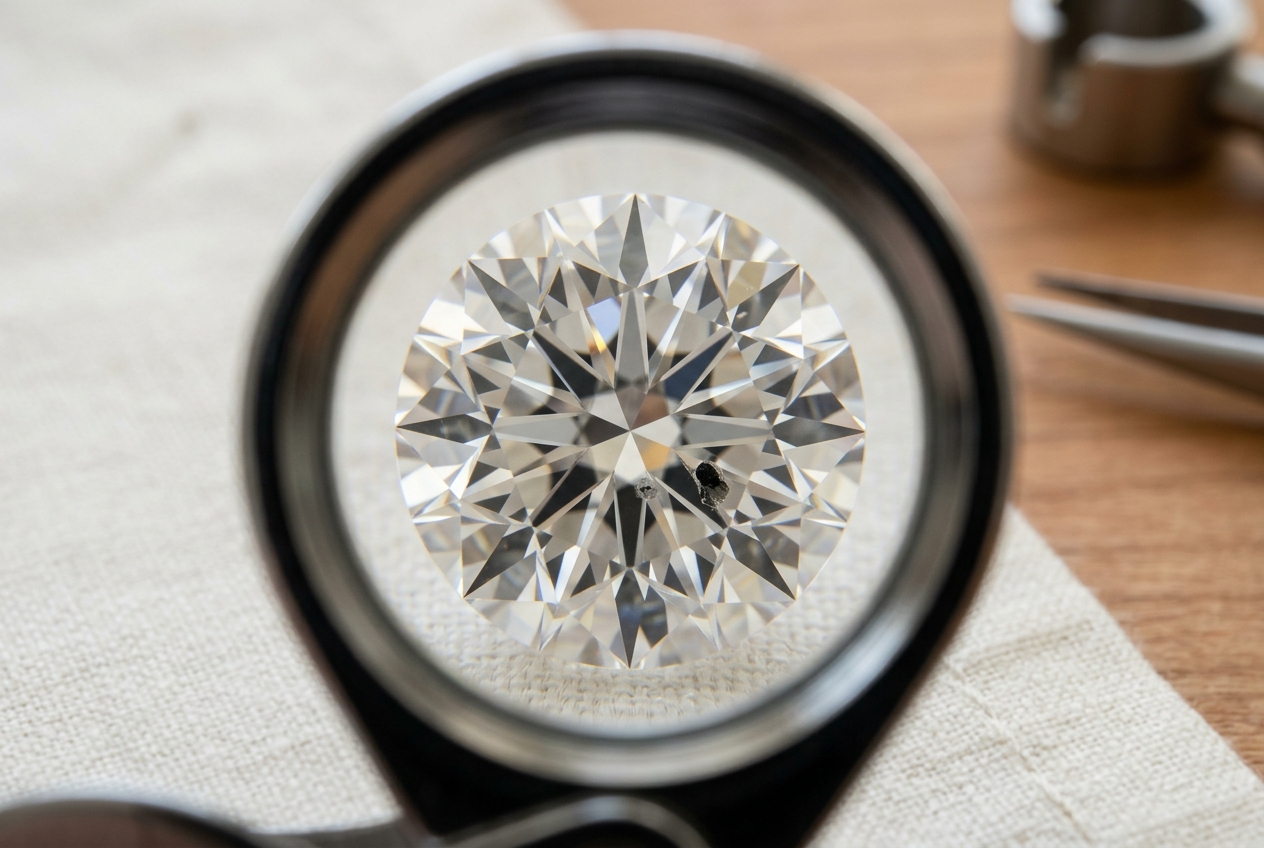
- Inclusion location and type. An SI1 with one tiny crystal under the table reads as eye-clean. An SI1 with the same total clarity grade but a feather running across a star facet is visibly worse. Both are SI1 on the report.
- Color tint character. A G can be cool-clean or slightly warm. An H can be barely-different-from-G or noticeably tinted. The grade is one band; the look varies inside it.
- Light performance and brilliance. The report doesn't quantify how the stone reacts to light in real wear conditions, only how its proportions sit on a chart.
This is why the gemologist's eye still matters. Two stones that read identically on paper can look meaningfully different in person, and the better-looking one will command 10–15% more in any informed market.
Why GIA differs from EGL, IGI, and in-house certs.
The diamond certification market has at least a dozen labs of varying rigor. The reputational order, in dealer practice, runs roughly like this:
- GIA — the strictest grader, considered the wholesale benchmark. A GIA H/VS1 will trade for what the market calls an H/VS1.
- AGS — historically equivalent strictness to GIA, with a stronger cut-grade scale; recently merged with GIA, transitioning out as a standalone lab.
- IGI — slightly looser than GIA on color and clarity. An IGI H/VS1 typically trades 10–20% below an equivalent GIA stone in dealer-to-dealer prices.
- EGL (multiple regional labs of differing strictness) — significantly looser than GIA, particularly on color. An EGL H/VS1 may grade as I/SI1 at GIA. EGL USA, EGL Israel, and EGL International all grade differently from each other.
- In-house jeweler certs — often used to pad grades for retail price justification. Treat as marketing copy, not certification.
A diamond's wholesale price is set by the grade that the wholesale market would assign — not by the grade on a softer certificate. A retail buyer who pays a GIA-equivalent price for an EGL stone is paying real money for a paper difference.
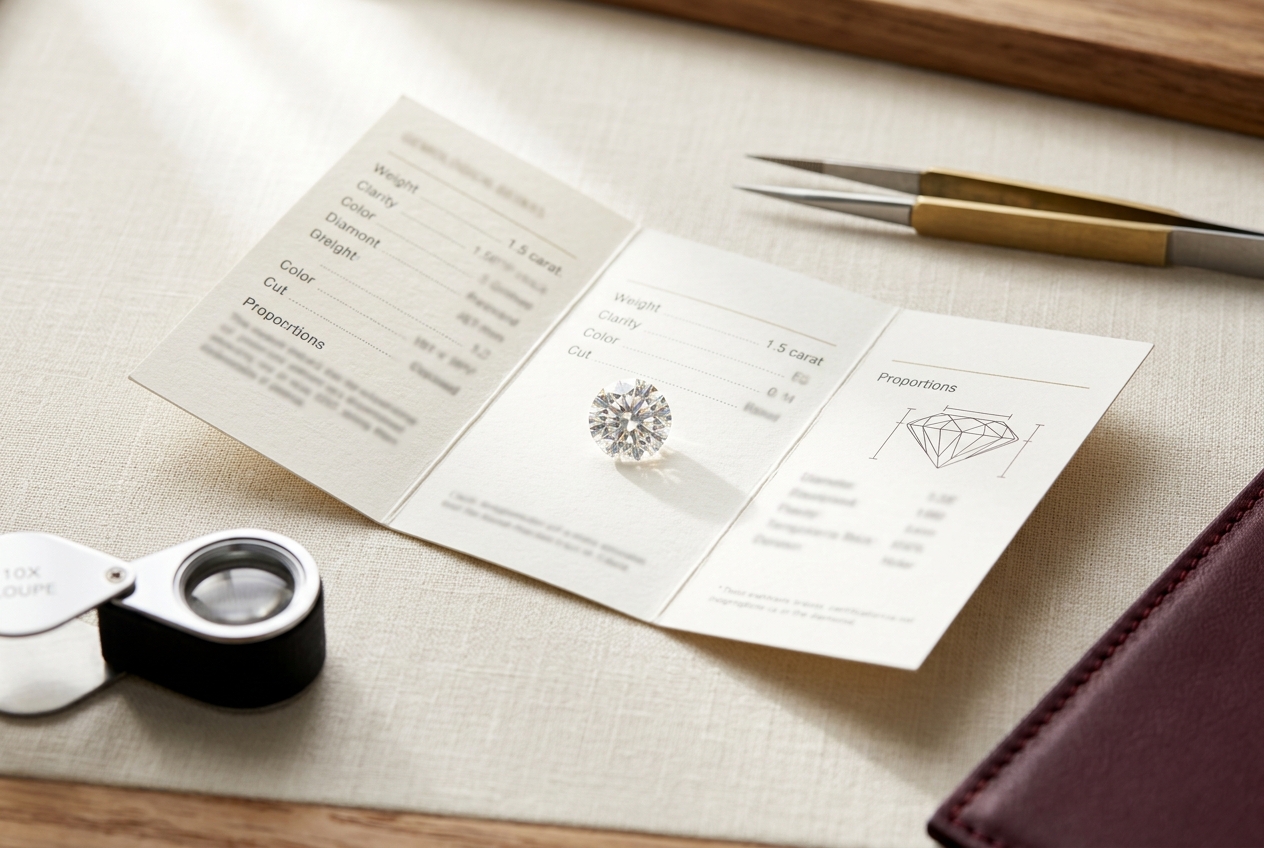
What an experienced gemologist looks at first.
When a stone arrives at our desk with a certificate, the first thing we do is set the certificate aside and examine the diamond independently. The certificate becomes a check against our own assessment, not the source of it. What we look at, in order:
- The girdle laser inscription. If the diamond has been laser-inscribed with a GIA report number, we verify it matches the certificate in front of us. Cert-and-stone swap fraud is rare but exists; the inscription confirms the document and the stone go together.
- The face-up appearance, naked-eye, at arm's length. Does the stone look bright? Is it visibly tinted? Is there any obvious inclusion that should not be there for the stated clarity grade?
- Loupe inspection of the table and crown. 10x magnification of the upper half of the stone. We look for clarity characteristics, where they sit, and whether anything unusual (laser drill holes, fracture-filling, surface-reaching feathers) is present.
- The pavilion under the loupe. Inclusions on the pavilion can transmit reflections through the table and affect brilliance. A flawless table with a pavilion crystal can still read as visibly off in real light.
- Light performance under multiple light sources. Daylight, fluorescent, and warm tungsten — a well-cut stone performs across all three. A poorly proportioned stone darkens or washes out depending on the light type.
Only after that independent assessment do we read the certificate to confirm or contradict our impression. Surprises are rare with GIA reports but happen with looser labs.
The dealer-side reality of certified vs non-certified diamonds.
Wholesale dealers pay roughly the same price for a GIA-certified D/VS1 round and a non-certified stone that would grade D/VS1 — but they pay it confidently in the first case and cautiously in the second. The certificate is a transferable promise of grade. Without it, every transaction down the line repeats the assessment cost. That repeat cost gets priced into the discount.
For retail buyers, the practical implication is that a GIA cert reduces the variance of what you might be getting. It doesn't guarantee the best stone within its grade band, but it forecloses the worst-case where the stone is materially below what's stated. Worth paying for.
For sellers — particularly estate sellers with old non-certified stones — getting a GIA report before selling typically pays for itself. A 1.5-carat round-brilliant with GIA paperwork sells for 15–25% more than the same stone certified by a softer lab, and 10–15% more than the same stone uncertified. The grading fee is small relative to that uplift on stones over a carat.
And: a GIA report does not expire. A 1990s-issue GIA cert remains valid documentation today, provided the diamond hasn't been recut or modified. The grade stands, regardless of how old the paper is.
What we tell every diamond buyer at the desk.
Read the cert. Then put it down and look at the stone. Then read the cert again. The two impressions should match. When they don't, the stone is telling you the truth — the cert is a piece of paper, the diamond is the asset. (For a different angle on documents that lie, see our companion piece on the twelve tells that catch a frankenwatch.)
For first-time fine-jewelry buyers more broadly: the same instinct that protects you on a pre-owned watch protects you on a certified stone. Look. Verify. Compare. Walk if it doesn't add up. (Our guide to first-time pre-owned Rolex buyers covers the parallel discipline on the watch side of the desk.)
The desk we run grades stones daily, certified and uncertified, against the same observational framework GIA uses. Bring a piece by and we'll show you what we see — and what the cert is telling you, vs. what it's leaving out.