
Chronograph vs Chronometer: Two Words, Totally Different Things
Say them out loud and they sound like cousins. Read them in a listing and your eyes slide right past the difference. But a chronograph and a chronometer are two completely separate ideas that happen to share a few syllables, and mixing them up is the single most common slip in watch collecting. One is a thing you can see and press; the other is a promise about how the watch keeps time. Let's untangle them for good.
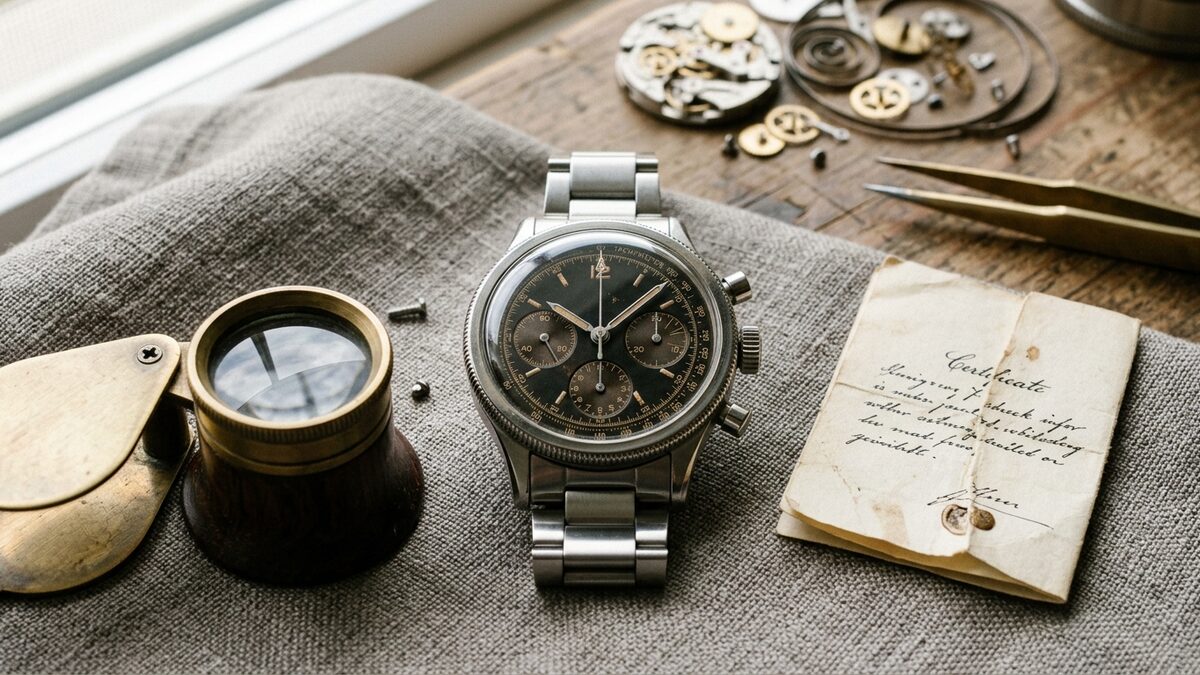
Start with the easy one. A chronograph is a stopwatch built into a watch. It is a complication, a feature, an extra job the movement does on top of telling the time. You recognize it instantly: usually two or three little sub-dials parked on the main face, plus a pair of pushers flanking the crown. Press the top pusher to start timing, press it again to stop, press the bottom one to reset to zero. That is the whole trick, and it is genuinely useful for everything from boiling an egg to roughly clocking a lap.
Those sub-dials, called registers, count the elapsed seconds, minutes, and sometimes hours. The big central seconds hand on a chronograph is often the stopwatch hand, sitting perfectly still until you fire it up, which surprises people who expect it to sweep constantly. Meanwhile the running seconds tick away quietly in a small sub-dial. If a watch has pushers and registers, you are looking at a chronograph. No certificate required, no testing involved, just a clever mechanical or quartz function you can operate with your thumb.
Now the slippery one. A chronometer is not a feature at all. It is a grade of accuracy, a certification a movement earns by passing an independent precision test. You cannot press it, you cannot see it working, and most of the time you would never know a watch was a chronometer unless the dial told you so. The two words live in different categories entirely: one describes what a watch does, the other describes how well it does the one thing every watch already does.
What COSC Certification Actually Tests
In Switzerland the body that hands out chronometer status is the COSC, the official chronometer testing institute. Brands send loose movements, not finished watches, and the institute runs each one for roughly two weeks across five positions and three temperatures. The headline number most people quote is the daily rate: to pass, a mechanical movement has to average somewhere between roughly minus four and plus six seconds per day. That is the famous window, and it is tighter than it sounds when you remember a movement is a few hundred tiny parts swinging thousands of times an hour.
The test checks more than a single average, though. It looks at how consistent the rate stays from position to position, how much it drifts as temperature changes, and how it holds up over the full run. A movement that races when the watch lies flat but drags when it stands on its crown can flunk even if its overall average looks tidy. Pass everything and the movement gets an official certificate and the right to wear the word chronometer on its dial. Fail and it is still a perfectly good watch, just one that did not earn the badge.
Worth knowing: COSC is the most quoted standard but not the only one. A handful of brands run in-house programs that test the finished, cased watch to even stricter limits, and some independent observatories issue their own certifications. The principle is identical every time. A neutral party measures the timekeeping and signs off on it. That is what separates a certified chronometer from a watch that simply happens to keep good time.
One, Both, or Neither: What It Means for Shoppers
Here is where it clicks. Because these are unrelated qualities, any watch can be a chronograph, a chronometer, both at once, or neither. A three-hand dress watch with no pushers can absolutely be a certified chronometer. A loud sports chronograph with three registers might never have seen a testing bench. And plenty of watches are quietly both, a stopwatch complication running on a movement that also passed certification. None of these combinations is a contradiction; they are just two boxes that tick independently.
So when you are scrolling pre-owned listings, read the spec sheet with this split in mind. If you want the stopwatch function, you are hunting for the word chronograph and the telltale pushers in the photos. If you care about certified accuracy, you are looking for the word chronometer, ideally backed by mention of a COSC or in-house certificate. Seeing both words is not redundant marketing; it is telling you the watch does two genuinely different things.
A couple of practical cautions. Sellers, and honestly even some brand catalogs, swap these terms by accident all the time, so do not trust a single word in a headline. Match it against the actual dial photos and the movement details. If a listing claims chronometer but the watch is a quartz piece, ask whether the certification is current, because quartz chronometers exist but follow a different and stricter rate standard. And remember that an old certificate says how the movement performed years ago at the factory, not how it runs today after a few decades of wear; a watch can drift out of chronometer-grade accuracy and still legitimately carry the printed label, which is a strong argument for budgeting a service into any older purchase.
The shortcut to keep in your head is almost silly, but it works. Chronograph has the extra g, like the g in stopwatch button you go and press. Chronometer ends in meter, the thing that measures, because it is all about measured precision. Lock that in and you will never confuse a feature you can use with a grade you have to earn. Two words, totally different things, and now you can spot the difference faster than most of the people writing the listings.